
April 2026
Speaking a CEO’s Language—Research Is the Starting Point
Wendy Muirhead │ April 14, 2026
Reading Time: < 1 minute
How many times in our careers have we attended a summit, conference, or meeting where we’ve heard the phrase, “Payroll deserves a seat at the table?”
For decades, I’ve heard that discussion. Payroll departments report through HR or finance—or occasionally, I’ve heard teams report to the Chief Accounting Officer—but often, the debate or subsequent proposal is that payroll needs a Chief Payroll Officer (CPO).
I had the privilege to present a workshop at PayrollOrg’s 2025 Payroll Congress in Orlando, where I discussed how to keep payroll on a board agenda. I wanted my session to make a significant difference to my audience. Drawing on my many years of experience working with CEOs and executive teams, I focused on what I learned matters to them.
Since coming out of the pandemic, I’ve noticed that organisations across all vertical markets are finding it more difficult to gain access to capital allocation, yet if payroll departments want to change something in their business, they must get the buy-in of the business.
Pondering my own experience of what could be helpful to our payroll community, I started asking myself, “What matters to payroll leaders?”
The following are my thoughts:
- Doing a Great Job—They truly care about their work and their profession
- Their People—It is not uncommon to meet with teams whose people are stretched a million ways trying to deliver for their organisation
- Expertise—When things happen in business, my colleagues would like to be involved in the discussion, so they can bring insight and analysis to help the business fully understand the impacts and risks that come with planning, including future implications
I thought about these areas. Payroll people are great at many things, including regulatory compliance and accuracy. They’re detail-oriented and have a passion for service. Many do not see themselves as salespeople and do not consider it part of the job.
Yet, requesting capital allocation means making the most compelling business case—a sales proposition or pitch—to capture the board and the CEO’s attention. With coaching or consulting, payroll professionals can learn to focus and build on this skillset.
 Know Your CEO
Do payroll leaders really know their CEO? Some may have an understanding or enjoy a richer relationship; however, people are complex, and CEOs are no different. A CEO may have an outward persona; one strictly for the boardroom. Learning more about what matters to their CEO is important.
I was presenting in London with a room of experienced global payroll leaders and asked, “Who here attends board meetings or executive team meetings?” The room reacted with the unanimous response of, “I couldn’t think of anything worse!” This, of course, was followed by what I presumed to be nervous laughter.
The reality is that great payroll people don’t want regular attendance. They do want to be brought in on the areas that matter so they can share their opinions, values, and insights ahead of the decisions being made. When the opportunity arises, they want the opportunity to fully explain their rationale for why it matters.
Reporting to the board or C-suite is necessary, but it is different than other circumstances. Payroll leaders will typically present their data points to their department heads who will share their insights to the board. However, there are areas of missed opportunities with this approach.
Missed Opportunities
The most important missed opportunities include the following:
- Payroll leaders do not get their own direct relationship with the C-suite
- Misinterpretation or personal bias can occur across the data that is shared. For example, the data points gathered through payroll can be indirectly or inaccurately represented when other department leaders—such as finance or HR—present this data. People often lean into what they know rather than reviewing the full dataset.
Payroll delivers, even if it means payroll teams work day and night to make the payrolls 100% accurate and on time. Long hours, manual checking, and sheer grit enable payroll teams to toil through workarounds and inefficiencies, achieving accurate and timely results.
This insight into how great results happen is often not considered. C-suite members may overlook the effort required by the payroll department to achieve these critical results. As a result, C-suite members may question the need for further investment if the outcomes are more than satisfactory.
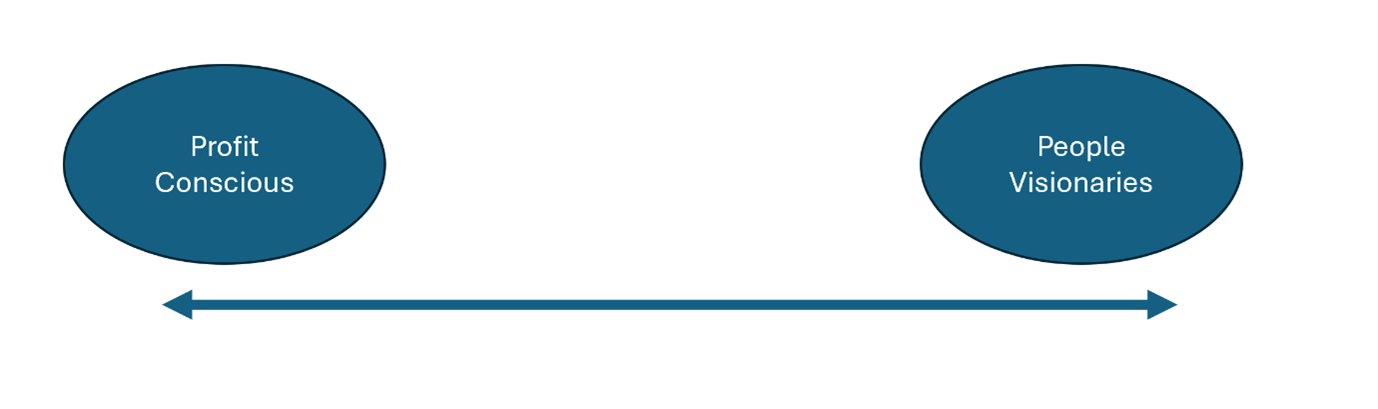
Including payroll as a regular agenda item to present data insights offers significant value. It is equally important to understand the CEO’s priorities and ongoing business growth strategies. The graphic shows that there are two ends of the spectrum with CEOs.
“Profit Conscious” CEOs are always looking at the bottom line, whereas the other end is driving the “People Vision.” Payroll impacts all areas in between.
What Is the Role of the CEO?
CEOs are responsible for the following:
- Leading and executing the organisational strategy for growth
- Building and managing the executive team
- Overseeing organisational operations
- Allocating capital
- Reporting to the board
Even the smallest businesses have a plan for growth. So, understanding this area is critical when you are after a capital allocation. During my Payroll Congress workshop, I shared with payroll leaders how they can access this group and a framework to achieve this objective.
If your business is growing, and your operational team cannot deliver this growth without significant risk, then you need to ask for investment.
In the Boardroom
Helping payroll leaders really understand what happens in the boardroom, and the psychology of those around the board table, is critical. Ask yourself the following:
- What type of CEO leads your business?
- What are their goals for growth and how are they intending to drive the growth strategy?
- What really matters to the CEO, especially the persona they display in the boardroom (rather than a “main stage” show)?
When you thoroughly research these areas, you gain a deeper understanding of where to start and how to present your case. People buy from people, so having a relationship is critical. It’s not the main element, but it will often help to accelerate the success of your request, especially when you are asking for money.
Yes, you need a business case, robust data, and metrics, but you also need to do your research on the people around the room. Keep a close connection to the business and learn what is impacting critical business decision-making.
For example, try not to present your business case for change when you have just had a bad sales quarter, or war has broken out in your local region. Sometimes we cannot plan for events that impact our world, but if you have done the research, aligned with the wider business goals, engaged your fellow colleagues to empower your business case, and demonstrated the value of how payroll can support the overall business goal, you will have a greater success rate.
Remember this fundamental: payroll impacts people. It’s why they work. It’s the biggest detractor if it goes wrong. For businesses to continue to grow, you need great talent. Great talent will stay in organisations that they know are looking after them and that they trust. For business to thrive, payroll needs the investment to ensure it can deliver to the new generations coming into the market.
Wendy Muirhead is a Founding Partner at WH People, based in Paisley, Scotland. She has spent more than 23 years in finance, HCM, and the payroll industries supporting organisations to grow. She is a member of PayrollOrg’s Global Payroll Editorial Advisory Board and is incredibly passionate about supporting inclusive, diverse cultures within organisations.